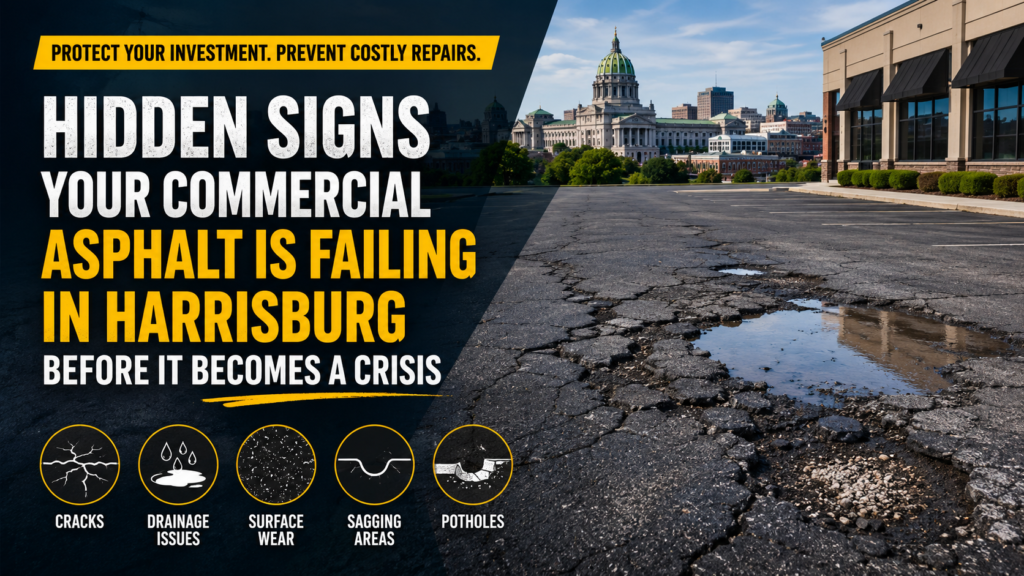
Most commercial property managers in Harrisburg are familiar with the obvious signs of asphalt failure: large potholes, extensive cracking across the entire lot, or sections of pavement that have completely collapsed. But by the time these dramatic symptoms appear, the underlying failure has typically been advancing for months or years and the cost of intervention has grown dramatically. The most valuable skill in Commercial Asphalt Failing Harrisburg pavement management is recognizing the hidden or early-stage signs of failure before they become structural crises. In Central Pennsylvania climate, where freeze-thaw cycling accelerates every form of deterioration, reading these early signals and responding quickly has outsized financial value.
Subtle Surface Changes That Signal Deeper Problems
- Longitudinal cracks parallel to pavement edges: Cracks running parallel to the edge of a parking lot, typically within 12 to 18 inches of the perimeter, are often the first visible sign of edge failure progression. They indicate the base beneath the pavement edge has begun to break down and the surface is starting to separate from its structural support. These are not merely cosmetic they are the leading edge of more extensive failure advancing inward.
- Surface depression or birdbath areas: Areas where the pavement surface has sunk slightly, creating low spots that collect rainwater and dry more slowly than surrounding areas, indicate settlement of the base or sub-grade. These depressions signal that the base is compressing often from saturation or seasonal movement of expansive clay sub-grade common in parts of the Harrisburg area.
- Isolated surface crumbling without obvious impact damage: When surface aggregate begins separating from the binder in localized areas without any physical impact a process called raveling the binder in that area has degraded beyond the point where sealcoating will restore it. Raveling progresses from surface disintegration to structural exposure of the base.
- Hairline cracking in a uniformly regular pattern: A network of very fine surface cracks in a relatively uniform pattern indicates thermal stress cracking the asphalt binder has hardened to the point where it can no longer accommodate the expansion and contraction that Harrisburg temperature cycling demands. This is early-stage warning that active crack development is approaching.
Drainage Behavior Changes
Observant property managers notice changes in how a parking lot drains over time. A lot that previously drained quickly now has areas where water stands for hours after rain. Catch basin inlets that previously drew water effectively now seem overwhelmed by standard rainfall. These changes indicate either that surface grades have shifted due to settlement, or that drainage infrastructure is becoming inadequate both of which signal that water is spending more time in contact with the pavement structure and accelerating deterioration.
Line Marking Degradation as a Timing Signal
The rate at which parking lot line markings fade can signal surface condition. Markings on oxidized, aged asphalt degrade faster because oxidized asphalt provides a less adhesive base for traffic paint. A lot whose line markings are fading unusually quickly likely has a surface that is oxidizing rapidly meaning the binder is hardening and the surface is approaching active surface cracking. The appropriate response is sealcoating and crack sealing before winter, not simply restriping to restore visibility.
How Pavement Responds to Vehicle Loads
Property managers who pay attention can observe how pavement behaves under loading. Pavement that flexes visibly under the weight of a garbage truck or delivery vehicle creating a slight deflection visible to a trained observer is indicating base weakness. Visible deflection under moderate loads in an aging lot signals that the base is saturated, has lost compaction, or both. By the time deflection is visible, the base has typically been compromised significantly.
The Value of Annual Condition Assessment
The most reliable way to identify hidden asphalt failure before it becomes a crisis in Harrisburg commercial properties is a systematic annual condition assessment by a qualified pavement contractor. A professional assessment evaluates surface distress types and severity, drainage function, edge conditions, and observable structural response producing a condition rating that tracks the pavement progression through its lifecycle and identifies the optimal intervention timing. Research consistently indicates that every dollar spent on preventive maintenance at the right lifecycle stage saves four to six dollars in heavy rehabilitation costs later.
Conclusion
Commercial asphalt failure in Harrisburg announces itself through subtle early signs that precede dramatic failures causing liability, customer complaints, and capital emergency expenditures. Longitudinal edge cracks, surface depressions, localized raveling, drainage behavior changes, and pavement deflection under load all signal failure advancing below the surface. Property managers who learn to read these signals, respond at the early-stage maintenance window, and maintain annual condition assessments protect their commercial pavement investments and avoid the compounding costs of reactive emergency repair.